Distributed range & status
Found in all zones of Sri Lanka up to 1800m but common in low country dry zone. Near Forests & grass lands, paddy fields & gardens vicinity of water such as ponds & lakes.
Scales
rostral |
|
frontal |
|
supraoculars |
|
parietals |
|
prefrontals |
|
nasals |
divided |
internasals |
1 pair |
loreals |
|
preoculars |
1 |
postoculars |
3 |
temporals |
(1+1) or (1+2) |
Supralabials |
8 (3-5 connected with the eye). |
mental |
|
infralabials |
|
sublinguals |
|
coastals |
|
ventrals |
118-161 |
anal |
|
subcaudals |
46-89 |
19 mid body scale rows are present & are elongated. Keels present.
Characteristics
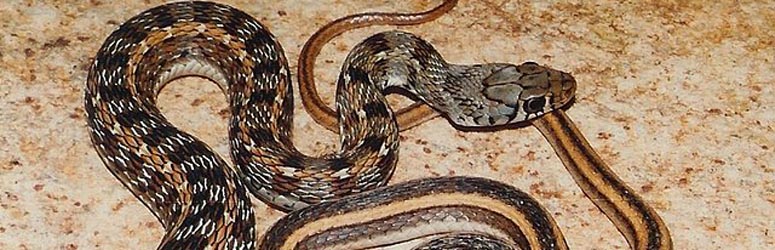
Middle sized, dainty, striped snake with a head distinct from the neck region. Head is dorsoventrally flattened with a narrow snout. Big circle pupils present in eyes. Long tail is present.
Colour
Head is olive gray to greenish grey & the dorsal body is brown colour. Some may even have yellow heads. Two bright longitudinal stripes run along the dorsal body. Orange stripes run along dorsolaterally on 5-7 scale rows. Pattern of these may vary. Skin between scales may be light blue or red colour. Ventral scales are white in colour; each may have a dot on them. Eye area & labials are yellow in colour. Pupil of the eye is golden colour. Orange tongue present with a black tip.
Venom
They’re non venomous.
Dentition
Data not found.
Behavior
They are diurnal & in the dry zone they have the ability to aestivate. When held from the tail there is a tendency for it to break its tail to release it self (caudal autotomy). When excited they show the skin between the scales which are red or light blue but mostly do not bite. Some times they may show death feigning. Mainly shelters in rodent burrows & termite mounds. Tendency to be bitten is very low & are non poisonous.
Breeding
They are oviparous snakes. They lay 5-15 eggs at once.
Growth
At birth total length is 100-150mm & grows up to 300-500mm. Female snakes are longer than male snakes.
Food
Frogs, insects & insect larvae are their main diet. Also scorpion, fish & lizards are known to be taken as food.
|